
How to Spot Fake Designer Vintage Pieces?
Quick Summary
To spot fake designer vintage, check the details counterfeiters rarely get right: even, tight stitching, solid hardware with crisp engraved logos, and labels that match the brand's fonts and country-of-origin details from that decade. Natural wear in expected places also helps, since perfect, unused-looking pieces deserve a closer look.
- Genuine designer pieces usually have even, tight stitches running straight along every seam.
- Zippers, clasps and buckles should feel solid and move smoothly, with crisp engraved logos.
- Compare the inner tag to what that brand used in the same decade, including fonts and spelling.
- Real vintage shows age in natural places, like edge rubbing and softened corners.
- Treat a single inconsistency as a question to investigate, not a verdict.
Table of Contents
- How to Spot Fake Designer Vintage Clothes and Bags
- How to Spot Fake Designer Vintage Shoes and Accessories
- How to Check Original Brand Clothes with a Barcode and Verify Before You Buy
- Frequently Asked Questions
How to Spot Fake Designer Vintage Clothes and Bags
Last Updated: November 14, 2026
Spotting a fake designer vintage piece comes down to details counterfeiters rarely get right: stitching, hardware, labels, and wear.
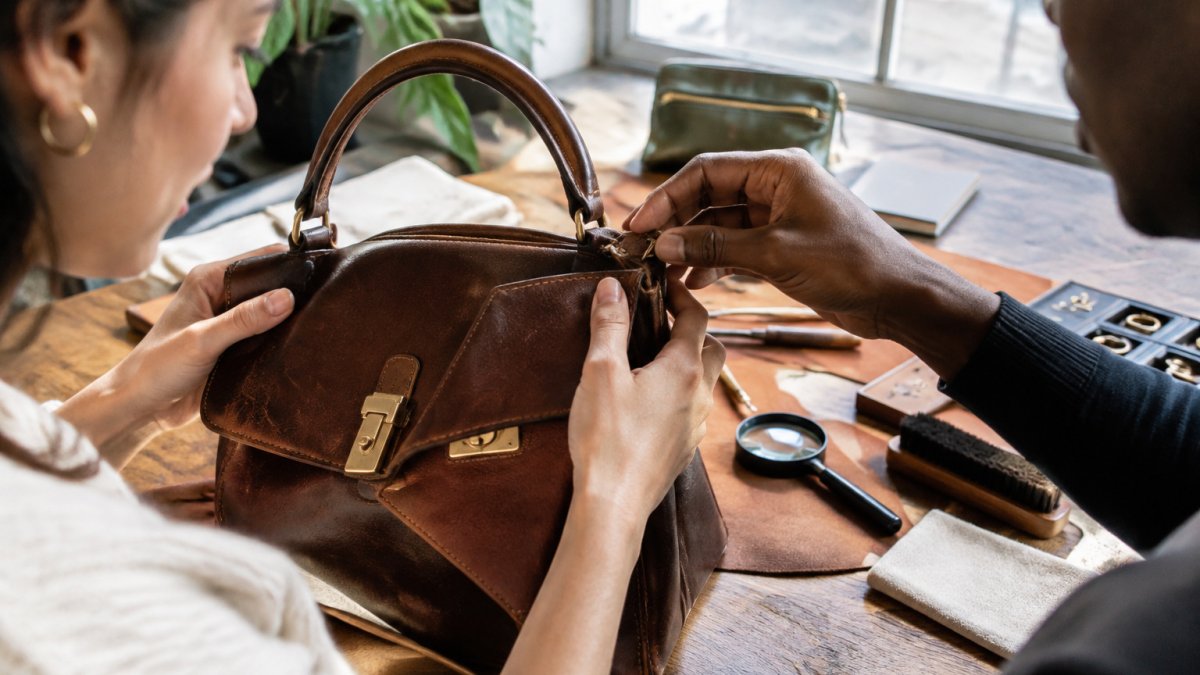
Start with stitching: genuine designer pieces usually have even, tight stitches running straight along every seam. Next, check the hardware, zippers, clasps, and buckles should feel solid and move smoothly, with crisp engraved logos, consistent finishes, and correct brand markings on zipper pulls.
Labels tell a lot too. Compare the inner tag to what that brand used in the same decade; fonts, spelling, and country-of-origin details should match. guidance on verifying designer goods and counterfeit markers
Finally, consider wear. Real vintage shows age in natural places, like edge rubbing and softened corners, perfect, unused-looking pieces from decades ago deserve a closer look.
How to Spot Fake Designer Vintage Shoes and Accessories
Shoes and accessories fail in different places than bags and clothing, so check them category by category.
Shoes. Genuine pairs feel dense and correctly weighted, with clean heel bonding, no excess glue, and even stitching inside.
Scarves and silk accessories. Hold the piece to the light: genuine silk reads clearly on the reverse with evenly stitched, slightly raised hand-rolled edges; blurred registration or flat machine-stitched edges are warning signs.
Wallets and small leather goods. Authentic pieces have smooth, consistent edges, stitched rather than glued lining, crisp engraving, and a date code whose placement and font match the era.
Jewelry and metal accessories. Real vintage jewelry often shows fine tool marks and a cleanly stamped maker's mark rather than a cast one; strongly magnetic clasps, flaked plating, and molded seams are common counterfeit clues.
Era context matters. A missing label, replaced zipper pull, or resized hem can be a legitimate repair rather than a fake. Treat a single inconsistency as a question to investigate, not a verdict.
Watch out: normal vintage wear, scuffed soles, softened leather, replaced heel tips, can look like sloppy counterfeiting, so judge the item as a whole and ask the seller about repairs.
How to Check Original Brand Clothes with a Barcode and Verify Before You Buy
Most guides stop at "check the label." A short, repeatable workflow you can run on any listing before money changes hands is more reliable.
Step 1: Identify the era first. Work out roughly when the piece was made from its silhouette, label style, and construction, since barcodes and date codes only mean something in the years a brand actually used them.
Step 2: Check the code against the brand's own tools. Where a brand offers a lookup tool, scan the code and compare the result with the garment's era, style, and country of origin. A mismatch is a prompt to ask more questions, not automatic proof of a fake.
Step 3: Verify the seller and the listing. Check the seller's history and whether other listings show the same photography and detail level. Listings that reuse stock photos, crop out labels, or refuse close-ups are worth walking away from.
Step 4: Request specific evidence. Ask for clear, well-lit close-ups of the main label, care label, country-of-origin tag, a seam, hardware engraving, and any serial or date code, plus a photo next to a ruler for scale. Repeated excuses are themselves a signal.
Step 5: Decide, and know when to stop. If era, labels, construction, and seller evidence are consistent, proceed with normal buyer caution. If two or more details conflict, or the seller won't supply photos, skip the piece.
At StyleMonky, we photograph garments pit to pit and list measurements and material from the label, so you can compare details before you purchase.
Watch out: a barcode or serial code that scans cleanly does not by itself prove authenticity, and one that fails to scan does not by itself prove a fake, always weigh the code against era, construction, and seller evidence together.
Run through this five-step check on any listing before you buy.
| Step | What to do | Key point |
|---|---|---|
| Step 1: Identify the era | Work out when the piece was made from silhouette, label style and construction | Codes only mean something in the years a brand used them |
| Step 2: Check the code | Scan the code with the brand's own lookup tool, if one exists | A mismatch prompts questions, not proof of a fake |
| Step 3: Verify the seller | Check seller history and whether photos look like stock images | Stock photos and cropped labels are warning signs |
| Step 4: Request evidence | Ask for close-ups of labels, seams, hardware and any date code | Repeated excuses are a signal in themselves |
| Step 5: Decide | Proceed if details are consistent; skip if two or more conflict | Skip the piece if the seller won't supply photos |
Frequently Asked Questions
How can I tell if a vintage designer bag is fake?
Start with the hardware, stitching and logo. Genuine bags usually have crisp, evenly spaced stitching, hardware with clean engravings, and logos that sit straight and centred. Check the inner tags and serial or date codes against the era the bag claims to be from. Counterfeits often show uneven stitch lengths, soft or blurred engraving, and labels with spelling or font errors. If something looks off, ask the seller for close-up photos of these exact areas before you pay.
Can a barcode prove that designer clothing is authentic?
Not on its own. A barcode or care label number can show that a garment was made for a given brand, but counterfeiters copy labels as well. Use the barcode as one check alongside stitching, fabric, hardware and labelling. For vintage pieces, the barcode format and label style should also match the period the garment is listed from, since older clothing often carried different label types than modern pieces.
What details should I check on vintage designer shoes?
Look at the stitching around the sole and upper, the quality of the leather or suede, the heel construction and the sole stamps. Genuine vintage shoes show wear that fits their age, such as even sole compression and softening of the leather, rather than a pristine finish. Check that the interior lining and any branding inside match the brand's known style for that era. Counterfeit shoes often have glue residue, misaligned logos and plastic-feeling materials.
